Multi-condition event
Multi-condition event allows you set up complex searches to match Use Cases not covered by other Use Cases. If your requirements are not met by the available Use Cases, Multi-condition event can be used to create custom or complex searches tailored to your specific needs.
It is recommended to use specific Use Cases whenever possible, as they are optimized for their respective scenarios and provide a simpler configuration experience.
Warning
Multi-condition event is a complex Use Case that requires a good understanding of the system and its capabilities. It is recommended to have prior experience with other Use Cases before attempting to set up a Multi-condition event search.
Go to Investigation Advanced search to set up a Search for multi-condition events. Alternatively, go to Live analytics New live analytics rule to set up a real-time detection of multi-condition events with alarm integration.
Select Source
Select the video you want to run the Search on from the left sidebar. The thumbnail image of the chosen video is displayed here.
Time interval Advanced search only
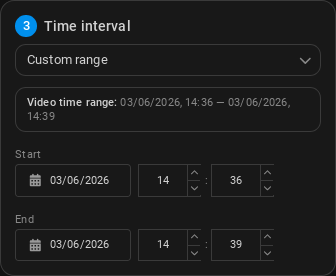
Select a time frame for the analytics to run.
- Entire video: Run the Search on the entire video duration, from the start timestamp to the end timestamp (set during video registration).
- Custom range: You can select a custom start and end date and time to run the Search on. Type the desired date and time or select them by clicking the calendar icon.
Primary Event
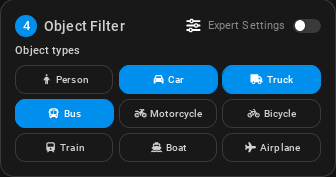
Select one or multiple object types you want to search for.
-
Sensitivity (Medium by default): The sensitivity level of the Search. The higher the sensitivity, the more likely it is to detect objects, but it may also result in more false positives.
-
Filter type: Select the type of filter you want to apply to the Search, such as "Line cross", "Moving".
Ticking the Expert Settings box will open additional configuration options for the Search, such as more object types to choose from.
Secondary Event
Select one or multiple object types you want to search for.
-
Sensitivity (Medium by default): The sensitivity level of the Search. The higher the sensitivity, the more likely it is to detect moving objects, but it may also result in more false positives.
-
Filter type: Select the type of filter you want to apply to the Search, such as "Line cross", "Moving".
Ticking the Expert Settings box will open additional configuration options for the Search, such as more object types to choose from.
Event matching settings
Here you can set the parameters for how the Primary and Secondary events will be matched to each other.
-
Maximum time difference (in seconds, 1 by default): The maximum time difference between the Primary and Secondary events for them to be considered a match.
-
Same object: If enabled, the Search will only consider it a match if the Primary and Secondary events are detected on the same object.
-
Events order: Select the order in which the events should be detected for them to be considered a match.
-
Any order (default): The Search will consider it a match if both events are detected within the specified time difference, regardless of the order.
-
Primary first: The Search will look for the Primary event first, and then check if the Secondary event is detected within the specified time difference.
-
Secondary first: The Search will look for the Secondary event first, and then check if the Primary event is detected within the specified time difference.
-
Expert Settings
- Maximum relative distance (in percent, 100 by default): The maximum distance between the Primary and Secondary events, relative to their size, for them to be considered a match.
Alarm integration Live analytics only
You can choose to integrate the Search with an alarm system.; whenever a stopped object is detected, an alarm will be triggered in the integrated system.
-
Alarm cooldown: (in seconds, 10 by default) The minimum amount of time that must pass between two detections before an alarm can be triggered again.
-
Alarm integration: Choose from the list of available integrations. The following integrations are available to be created in Integrations:
Results
All done - Clicking Search will immediately start the analysis and opens the Search Results screen.
Live analytics will produce real-time detections , and the results will be displayed in the Alarms screen. If an alarm integration is set up, an alarm will also be triggered in the integrated system.