Object count statistics
Object count statistics is a query that counts the number of objects in a video. The query stores the number of detected objects in a table, segmented by time intervals. This query is useful for analyzing the number of objects in a video over time, such as counting the number of people in a crowd or the number of vehicles in a parking lot.
The metadata can be further processed by exporting it to a third-party system, such as a webhook, or by using it in a custom application.
- Go to Investigation Advanced search to set up a Search for object counting.
Object count statistics is currently only available as a Search, not as a Live Rule.
Select Source
Select the video you want to run the Search on from the left sidebar. The thumbnail image of the chosen video is displayed here.
Time interval Advanced search only
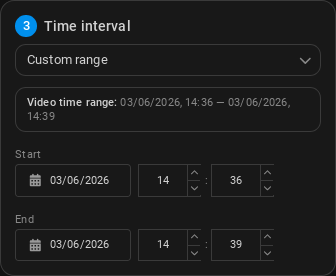
Select a time frame for the analytics to run.
- Entire video: Run the Search on the entire video duration, from the start timestamp to the end timestamp (set during video registration).
- Custom range: You can select a custom start and end date and time to run the Search on. Type the desired date and time or select them by clicking the calendar icon.
Object filter
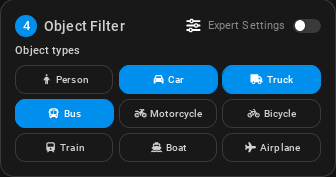
Select one or multiple object types you want to search for.
- Detection zone: Draw a polygon on the video frame to define the area where the objects will be detected. Left-click on the video frame to draw a polygon. Left-click again on the video frame to keep adding points to the polygon; double-click to finish drawing.
Drawing ROI is only supported on videos with a fixed camera angle (i.e. not on moving cameras). PTZ cameras are supported only in fixed position.
Note that currently only one ROI can be drawn.
Expert Settings
Ticking the Expert Settings box will open additional configuration options for the Search, such as more object types to choose from. Additional parameters:
- Sensitivity (Medium by default): The sensitivity level of the Search. The higher the sensitivity, the more likely it is to detect objects, but it may also result in more false positives.
Algorithm
- Time window (in seconds, 5 by default): Splits the selected time range into fixed windows of this length, then calculates the minimum, maximum, and average object count for each window.
Results
All done - Clicking Search will immediately start the analysis and opens the Search Results screen.
Live analytics will produce real-time detections , and the results will be displayed in the Alarms screen. If an alarm integration is set up, an alarm will also be triggered in the integrated system.